
Use seven practical cotton fabric checks to assess GSM, weave, shade, shrinkage and sample-to-bulk consistency before placing a B2B order.
What Makes Cotton Fabric Suitable for Bulk Production?
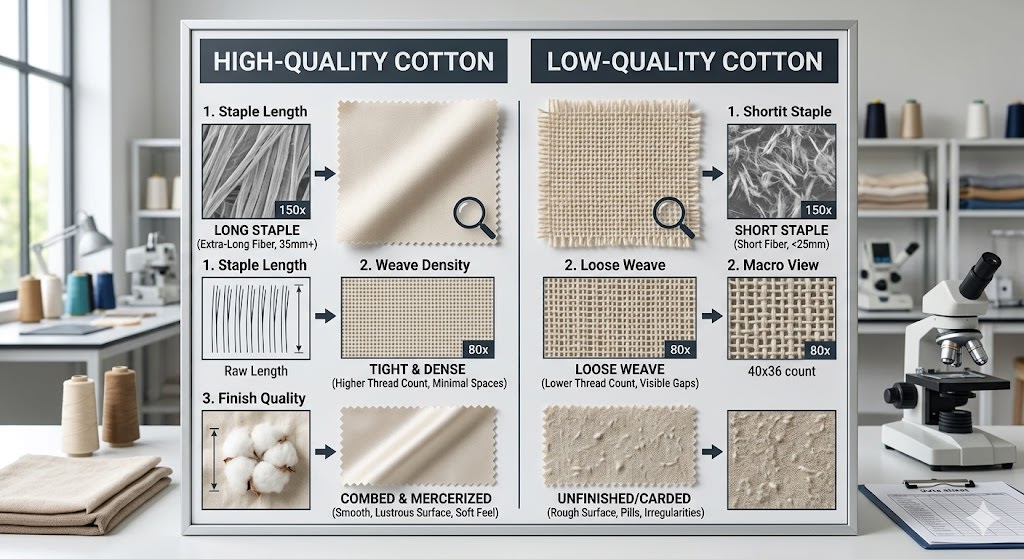
For a garment manufacturer or sourcing team, “high quality” should mean suitable for the intended product and consistent enough for production—not simply soft to the touch. Start with the garment application, then confirm the fabric specification: fibre composition, GSM, usable width, weave or knit construction, colour, finish and care requirement. A lightweight shirting fabric and a structured uniform fabric can both be good choices when their construction matches the job. Handfeel, wrinkle response and appearance are useful first screens, but they cannot prove fibre content, strength, shrinkage or colourfastness. Ask the supplier to state what is confirmed, what is based on a sample and what still requires testing. This gives purchasing teams a clearer basis for comparing quotations and reduces the risk of approving a fabric only because it looks attractive in a small swatch.

Seven Cotton Fabric Checks Before You Approve a Bulk Order
- Match the specification: compare composition, GSM, width, construction, shade and finish with the tech pack or end-use brief.
- Inspect the construction: review weave or knit uniformity, surface faults, holes, unwanted slubs, bowing or skew. Confirm whether any texture is intentional.
- Verify weight and usable width: GSM and width affect drape, coverage, consumption and marker planning, but GSM alone is not a quality grade.
- Review shade and finish: compare the approved sample with roll or lot references under consistent lighting and agree how variation will be judged.
- Check dimensional stability: test shrinkage, growth and shape change using the care process planned for the garment.
- Test for the application: depending on the product, review strength, seam behaviour, pilling, abrasion and colour transfer using agreed methods.
- Control sample-to-bulk consistency: record the approved standard, tolerances, inspection plan and repeat-order expectations before production.
Fibre length or an “organic cotton” label should not be judged from touch alone. Request current supporting documents or test information when either point is important. For broader planning, use the fabric selection guide for bulk garment production.
Turn the Quality Check into a Clear Cotton Fabric Inquiry
A useful sourcing brief allows a supplier to respond to the real production requirement rather than a broad request for “premium cotton.” Share the garment type, composition, target GSM, usable width, weave or knit, colour, finish, quantity, sample stage and required checks. Ask how the approved sample will be referenced for bulk lots, what tolerances need agreement and which details must be reconfirmed for repeat orders. Buyers can compare available specifications in the bulk fabric catalogue and review the cotton woven fabric range. Amrita Global Enterprises (AGE) is an Ahmedabad-based B2B fabric manufacturer and supplier serving garment and textile buyers. Use the bulk fabric inquiry page to Send Fabric Inquiry or Request Fabric Samples. Include the specification and application so availability, MOQ, sampling, pricing and dispatch details can be confirmed for the individual requirement.
